Stanley Ghyll Force
Getting there, parking, where to stay and the fells you can walk straight from Stanley Ghyll Force.
Summit forecast
Harter Fell (Eskdale) summit, verdict for 27 October: Save it for another day · Too windy for the tops
11°C at the summit, gusts 55 mph
Weather on the tops, not whether a route suits you. One summit, the highest within 5 km, not the valley · scored for 27 October by the site’s own scorer · all 214 ranked · Weather data by Open-Meteo.com (opens in new tab)First light
The sun reaches the Boat How, Illgill Head & Whin Rigg start about 08:31 in October · sunrise 07:42
From the terrain around the start (Copernicus GLO-30), mid-month · how we work it outStanley Ghyll Force at a glance
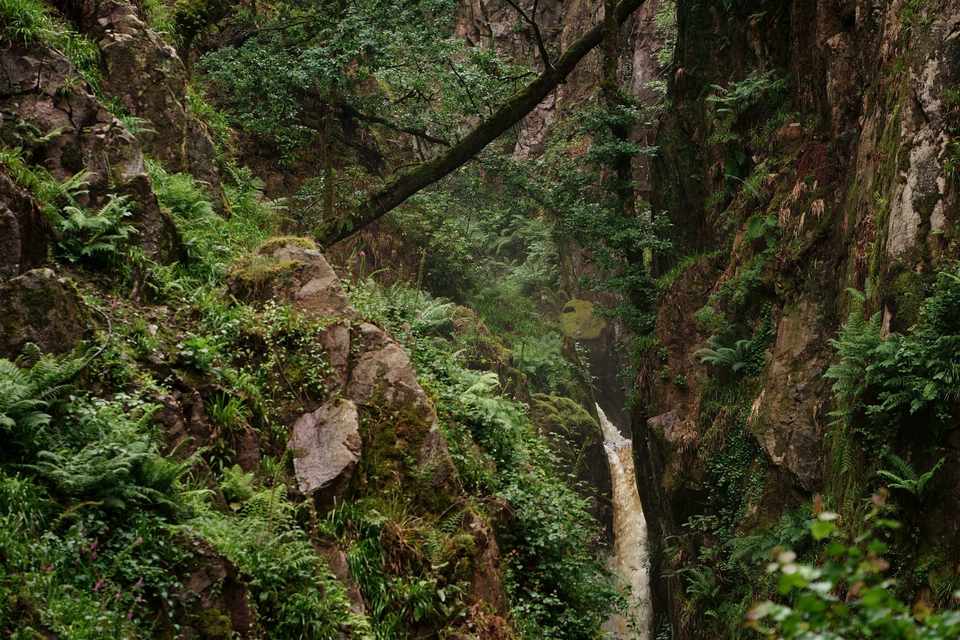
Stanley Ghyll Force — sometimes called Dalegarth Falls — is a ~60-foot (18 m) fall at the head of a deep, narrow, tree-hung gorge in quiet Eskdale. The walk up the ravine, crossing the beck on footbridges as the walls close in, is genuinely exciting. The airy top viewpoint has a real, serious drop, so it demands care (see below).
Quick facts
| What it is | A ~60 ft (18 m) waterfall in a deep, wooded gorge at the head of Stanley Ghyll, Eskdale |
|---|---|
| The walk | A short but rough gorge walk (~1.5 miles round from Dalegarth), crossing footbridges into the ravine |
| Can you swim? | No — the pool below the fall is beyond the closed stretch of path |
| Dogs | Fine on the lower paths (lead near the gorge and the drops); the upper ground is steep and airy |
| Pushchair / family | No — a rough, steep, exposed gorge; sure-footed adults and older children only |
| Getting there | Eskdale: park near Dalegarth / Trough House Bridge, or arrive on the Ravenglass & Eskdale Railway |
| Best time | After rain for the fall in spate; a dry, settled day for safe footing in the gorge |
| The fell above | Harter Fell (Eskdale) and the quiet Eskdale skyline |
Where is Stanley Ghyll Force?
Stanley Ghyll Force near Eskdale, in the Lake District. Zoom and pan to explore — or see every Lake District waterfall on one map.
The walk to the falls
From near Dalegarth in Eskdale, a path leads up into the wooded gorge of Stanley Ghyll, crossing the beck on a series of footbridges as the ravine deepens and the rock walls draw in — it's a genuinely atmospheric approach, a little over 1.5 miles there and back. It is not one of our mapped routes, so there is no line, GPX or walked record for it here. The lower gorge is straightforward; higher up the ground becomes steep, rocky and slippery when wet, so good footwear matters. The last stretch is closed. The Lake District National Park Authority, which owns the gorge, says that in April 2021 “rock falls just above the final bridge badly damaged the narrow path between the bridge and lower falls” and that “we will have to keep this path closed temporarily”; it adds, “For your own safety please do not try to cross the fencing to access this land.” To see the falls it has opened “a Victorian-inspired cantilevered viewing station” on the upper crest of the ravine, which it says gives “an open view of the upper, middles and lower falls” (Lake District National Park, Stanley Ghyll, read 28 September 2026; the page carries no date). A lovely way to arrive is on the narrow-gauge Ravenglass & Eskdale Railway (the "La'al Ratty"), walking up from Dalegarth station.
Routes that start near Stanley Ghyll Force
| Route | Distance | Ascent | Estimate |
|---|---|---|---|
| Boat How, Illgill Head & Whin RiggStart 1.2 km away (straight line) · not yet walked | 20.67 km | 1170 m | ~6–8¼ h |
| Birketts Around Devoke WaterStart 1.9 km away (straight line) · not yet walked | 8.89 km | 415 m | ~2¼–3½ h |
| Green Crag & Great Whinscale — the wild Birker Fell roundStart 1.9 km away (straight line) · not yet walked | 12.03 km | 544 m | ~3¼–4½ h |
Routes starting within about 2 km of Stanley Ghyll Force, or on its doorstep at one of its car parks. Each time is the whole route’s, from a fast to a steady pace, and takes no account of stops, conditions or daylight — a guide, not a schedule.
Fells & walks near Stanley Ghyll Force
Straight-line distances from the centre of Stanley Ghyll Force — the nearest summits with a full guide on this site.
Places nearby: Eskdale · Hardknott Pass · Wast Water · Duddon Valley
All walks near Stanley Ghyll Force → — the routes we have mapped and every Wainwright and Outlying fell within about 5 km, ranked, with today’s conditions.
Safety at the top viewpoint
The Lake District National Park Authority has put a viewing station on the upper crest of the ravine: in its words, “to help people see the stunning view safely”, “a Victorian-inspired cantilevered viewing station is now open to the public”, giving “an open view of the upper, middles and lower falls” (Lake District National Park, Stanley Ghyll, read 28 September 2026). Away from it the ground at the top of the gorge can be greasy: keep well back from any unfenced edge; keep children and dogs close, and don't scramble for a photo.
Swimming
The pool below the fall is beyond the closed stretch of path, so this is not a place to swim; Eskdale's river pools downstream are the alternative.
When to go
Stanley Ghyll is at its most spectacular after heavy rain, when the fall fills the gorge with noise and spray — but that's also when the rock is most slippery, so the ideal is a dry, settled day soon after a wet spell. It's a quiet corner of the Lakes year-round, so you'll rarely find it crowded; spring and autumn are especially atmospheric in the wooded ravine.
The setting & its story
The gorge is famous for its lushness: cool, shaded and damp, it grew a dense canopy of rhododendron over the last century, much of which has recently been cleared to restore the native woodland and rare mosses and ferns that thrive on the ravine walls. It sits in Eskdale, one of the Lakes' remotest and most unspoilt western valleys, reached by the little steam railway from the coast. The name comes from the Stanley family of nearby Ponsonby, former landowners; a ghyll (from Old Norse gil) is exactly this — a deep, wooded ravine with a stream.
Family, dogs & accessibility
This is a rough, steep, exposed gorge walk, not an easy stroll: it's not suitable for pushchairs or wheelchairs, and while sure-footed older children will love the drama of the footbridges and the ravine, the unfenced drops at the top demand constant care with young ones. Dogs are fine on the lower paths on a lead, but keep them well away from the gorge edges. Come properly booted, and treat the upper viewpoint with the caution it deserves.
The fell above
Above Eskdale rises Harter Fell (Eskdale), and beyond it the high ground towards the Scafells. The Ravenglass & Eskdale Railway makes a car-free visit genuinely easy.
Getting there & parking
Without a car: The nearest stations as the crow flies are Ravenglass (9 km away) and Drigg (11 km away). The bus map has every stop we hold.
Stanley Ghyll Force is in Eskdale, reached by car along the valley from the A595 coast road, over Birker Fell from the Duddon valley, or from the east over Hardknott Pass, or — much the nicest way — on the Ravenglass & Eskdale Railway to Dalegarth station and a walk up. It's a remote valley with few facilities, so come prepared.
Parking, toilets and buses: Parking near Stanley Ghyll Force
Parking near Stanley Ghyll Force
Toilets, food and shops near these car parks
All the car parks around Stanley Ghyll Force on the parking map →
Straight-line distances from the centre of Stanley Ghyll Force. We publish whether a car park charges, and who runs it, but never the price — tariffs change and a stale one is worse than none, so check the sign or the operator’s own site on the day.
Vehicles are left entirely at their owner’s risk. We list places people park; we cannot vouch for any of them. Judge it on the day: take valuables with you, leave nothing on show, and if a spot feels wrong when you get there, park somewhere else.
Getting there across the Lake District: Buses · Parking map · By train · By boat
Frequently asked questions about Stanley Ghyll Force
How do you get to Stanley Ghyll Force?
It's in Eskdale, in the quiet south-west of the Lakes. The nicest way is on the narrow-gauge Ravenglass & Eskdale Railway to Dalegarth station, then a walk of a little over a mile up into the gorge; by car, park near Dalegarth or Trough House Bridge (limited). A path leads up the wooded ravine, crossing the beck on footbridges. The last stretch, from the final bridge to the lower falls, is closed: the Lake District National Park Authority says rock falls in April 2021 damaged it and asks visitors not to cross its fencing.
How high is Stanley Ghyll Force?
Stanley Ghyll Force (also called Dalegarth Falls) drops about 60 feet (18 m) at the head of a deep, narrow, wooded gorge — a dramatic waterfall setting, even if it's not the highest fall. It's most spectacular after heavy rain.
Is the Stanley Ghyll Force viewpoint dangerous?
The Lake District National Park Authority, which owns the gorge, has opened a cantilevered viewing station on the upper crest of the ravine “to help people see the stunning view safely”. Away from it the ground at the top can be greasy: keep well back from any unfenced edge; keep children and dogs close, and don't scramble for photos. The path below, from the final bridge to the lower falls, is closed, and the Authority says “For your own safety please do not try to cross the fencing to access this land”.
Sources: Lake District National Park Authority - Stanley Ghyll (read 28 Sep 2026) (opens in new tab)
Can you swim at Stanley Ghyll Force?
No. The pool below the fall is beyond the closed stretch of path, so this is not a place to swim; Eskdale's river pools downstream are the alternative.
Events across the Lake District
Planning a trip around a show or festival? See our Lake District events & festivals guide for what's on near Stanley Ghyll Force — traditional Lakeland sports, agricultural shows and seasonal events, month by month.