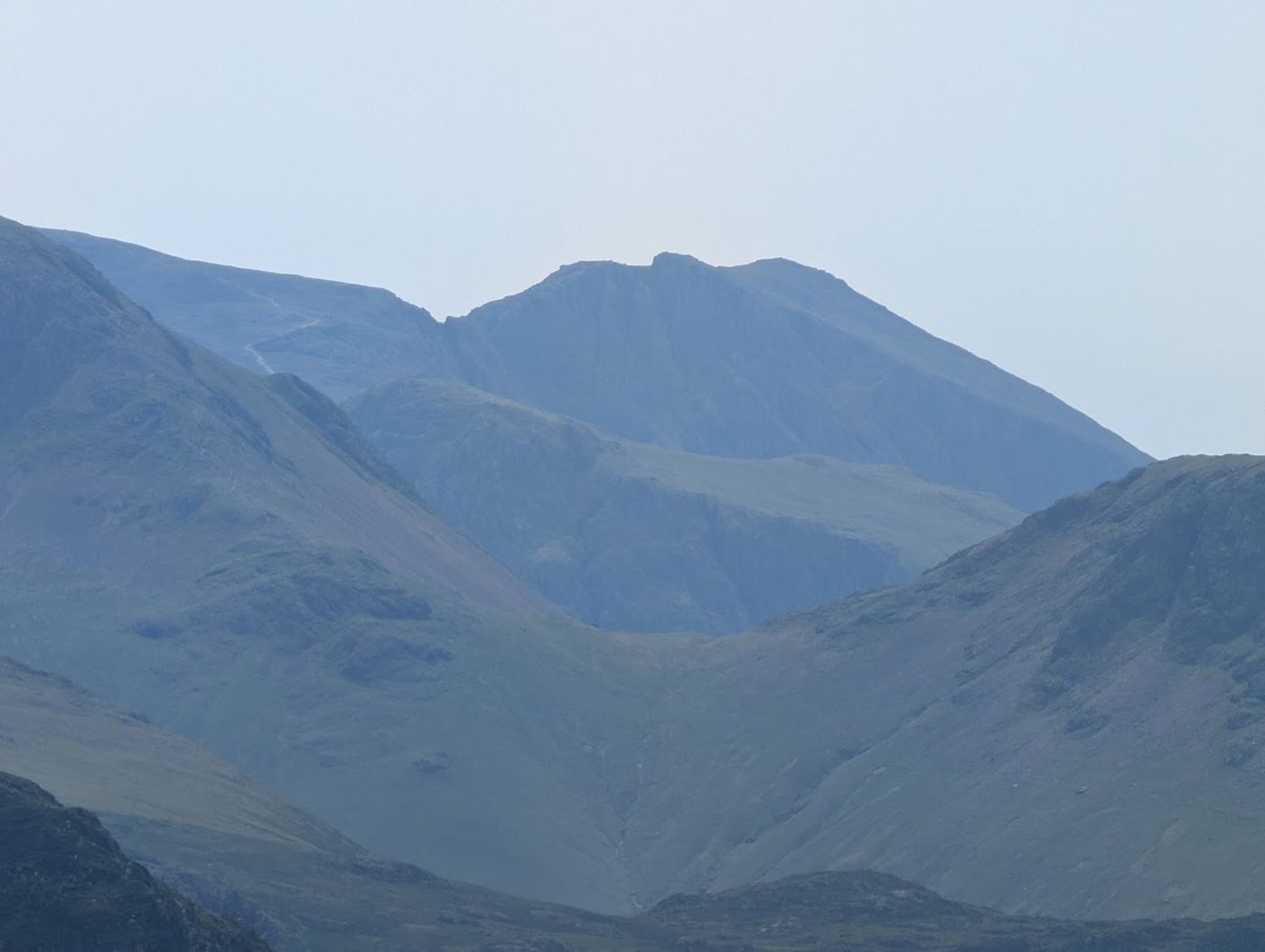
Scafell Pike via the Corridor Route
Photo: Thorneh at English Wikipedia, Public domain, via Wikimedia Commons (opens in new tab)
Start Seathwaite (Borrowdale)
Getting here Parking: Seathwaite Farm, Borrowdale (farm field, paid), 0.2 km from the start (straight line). Bus: the 78 stops at Seatoller, at National Trust car park; from there it is 2.2 km and 79 m of ascent to this start. And the same back: about 20.2 km in all, with the walk. Getting there ↓ · Route map ↓
Hardest part Severe exposure: Dangerous ground on the ascent and rocky, awkward footing on top; the descent is a difficult, easily-missed line in cloud. Severe – our judgement from the map and the route’s record; not walked yet Easy scramble: a short down-climb over a rocky lip at Greta Gill (about km 5.2).
Before you choose
- Never attempt Broad Stand (the direct link to Scafell) — it's a graded rock climb and a notorious accident spot.
- Rough, rocky ground and a boulder-field summit that is very hard to navigate in cloud — carry map, compass and GPS.
- A long, committing mountain day; start early and watch the time.
- Piers Gill: go round it, not into it — and there is no phone signal here. Where the Corridor Route reaches the head of the gill, the safe line is to go right round the corner of the crossing and slightly uphill, well away from Piers Gill, following the path down to Sty Head. Do not drop toward the gill or try to walk down the bed of the stream — it is a canyon of waterfall pitches (Wasdale Mountain Rescue Team: “do not attempt to walk down the bed of the stream”). The bank paths are worse than they look: the west (river-left) bank has no path at all, and WMRT report fatalities there in recent years; the path on the other bank has steep sections above big drops and a record of serious accidents — if you get onto it and into difficulty, turn around and retrace to the Corridor Route rather than press on. There is no mobile phone coverage around the gill, so do not sit and wait for a call to connect — move only if you can do so safely, and otherwise make yourself seen and heard. See phone & satellite SOS. Guidance drawn from Wasdale Mountain Rescue Team’s published page on Piers Gill.
- Greta Gill — and the false track that isn’t the route. Lower down, the Corridor Route crosses Greta Gill after a rock step that Wasdale MRT warn “can be hazardous or impossible if the weather is wet.” Do not follow what looks like a track down the north (river-right) bank of Greta Gill: it is unconsolidated, has steep drops into the gill, and is not the continuation of the Corridor Route. Stay on the made path.
- At the path junction above Lingmell col it is easy to miss the turn and carry on onto steep ground above Piers Gill. Know the junction, navigate carefully by compass in mist, and don't follow the gill downhill.
Hazard & incident notes: Lingmell · Scafell Pike
Conditions on this route
We score every Lakeland Wainwright each morning on cloud, wind, rain and underfoot, and this route crosses 2 of them. The worst summit governs the verdict — a route is only as kind as its roughest top.
Modelled guidance — not a substitute for the mountain forecast or your own judgement. See how every fell ranks today →
Daylight & turnaround
Daylight is short from October to February — check today’s sunrise and sunset before you set off, and carry a head-torch and spare batteries. On short days, decide your turn-back time before you start.
See also walking in bad weather and today’s conditions.
Route map
1 Lingmell2 Scafell Pike
Easy 73%Moderate 24%Hard 4%Severe
Heights on this chart and its high point are read from the track itself (a terrain model sampled along the line, or a GPS recording), so a top can differ from its listed height, usually reading lower.
Free mapping: OpenTopoMap / OpenStreetMap, with SRTM elevation data (switch layers top-right).
The elevation profile is under the map; the stage notes follow.
The walk, stage by stage
- 1
Seathwaite (Borrowdale) → Lingmell (7.0 km, 694 m)
Start at Seathwaite farm, passing through the yard and heading south along the main valley track. After about 1 mile, cross Stockley Bridge and immediately pass through a gate, taking the right-hand path that climbs the rocky spur (Greenhow Knott) beside Taylorgill Force waterfall. The gradient eventually eases as you follow Styhead Gill up to Styhead Tarn. Cross the footbridge near the tarn and continue to the Sty Head pass. Turn left at the stretcher box to pick up the fainter trail of the Corridor Route. This undulating path traverses the steep western flanks of Great End and Broad Crag. You will cross Skew Gill, negotiate a rocky down-climb, and cross the head of Greta Gill before arriving at Lingmell Col.
WaypointsStockley Bridge (stone packhorse bridge) Styhead Tarn Sty Head Mountain Rescue Stretcher Box Skew Gill & Greta Gill crossings.
Decision pointThe Sty Head Stretcher Box is a major junction marker. On the Corridor Route, the path is mostly clear but unmarked; look for wear on the rock and occasional small cairns.
Easy to get wrongThe Corridor Route features a famous "Bad Step" before Greta Gill. It requires a short, slightly awkward down-climb over a rocky lip (roughly 10-15 feet). It can be slippery when wet, but there are good handholds if you face inwards. The terrain across the Corridor Route is generally undulating, rocky, and involves minor scrambling. On Lingmell, crags drop directly from the summit — about 1,000 ft of cliff with 1,000 ft of scree beneath.
- 2
Lingmell → Scafell Pike (1.4 km, 242 m)
Upon reaching Lingmell Col (the saddle between Lingmell and Scafell Pike), you will join the busy main path coming up from Wasdale. Turn left (South-East) and begin the steep final ascent. The path zig-zags up heavily eroded scree, passes over some sloping rock slabs, and then transitions into a massive boulder field as you breach the summit plateau.
WaypointsLingmell Col junction, Scafell Pike summit plateau, the massive summit cairn and trig point.
Decision pointThe route from Lingmell Col to the summit is heavily cairned. In low visibility, follow these closely to avoid wandering off the plateau. CRITICAL NAVIGATION WARNING (Piers Gill): You will pass the top of Piers Gill right where the Corridor Route meets Lingmell Col. If you ever navigate this section in reverse (descending from Scafell Pike towards Sty Head): Easy to get wrong: The head of Piers Gill. Do not drop toward the gill or into its bed here — go right round the corner and slightly uphill, well away from Piers Gill, to pick up the path down to Sty Head. There is no phone signal at the gill, and accidentally descending into it is one of the most common and fatal navigational errors on the mountain.
Easy to get wrongThe gradient here is punishing (17% average), and the loose scree underfoot makes it physically demanding.
Scafell Pike → Broad Crag col (0.5 km, 0 m)
From the Scafell Pike summit, walk roughly 100 meters North-North-West to pick up the cairn line marking the descent, then bear North-East. You will drop steeply over extremely rugged, loose boulders into the saddle (col) separating Scafell Pike from Broad Crag. From the bottom of the saddle, climb up the opposing side. The path threads its way over a massive expanse of boulders, skirting just below the true rocky summit of Broad Crag.
WaypointsScafell Pike/Broad Crag Col.
Decision pointPay close attention to your compass bearing (North-East) when leaving the Scafell Pike summit. In thick mist, it is incredibly easy to accidentally head South or West down the wrong side of the mountain.
Easy to get wrongThis entire half-kilometer is a punishing boulder field. There is no flat path; you must step or hop from rock to rock. In wet or icy conditions, these boulders become highly treacherous.
Broad Crag col → Finish (7.0 km, 13 m)
Continue North-East over the boulder fields, passing the col below Ill Crag. The path will eventually descend east-north-east down to Esk Hause, a major plateau junction. At Esk Hause, turn left (North), dropping down a clear path toward Angle Tarn and Sprinkling Tarn. However, after about 250m, fork right to follow the path keeping Ruddy Gill on your left. This stream soon merges into the wider trough of Grains Gill. Follow the long, well-made stone path down the Grains Gill valley all the way back to Stockley Bridge. Cross the bridge and retrace your initial morning steps for the final mile back to Seathwaite Farm.
WaypointsIll Crag Col Esk Hause (crossroads shelter wall) Ruddy Gill / Grains Gill fork Stockley Bridge.
Decision pointEsk Hause is a crucial navigational junction. It is marked by a low stone wind shelter shaped like a cross. Ensure you do not accidentally descend South into Eskdale or East into Langdale here. Once you are alongside Grains Gill, the valley naturally funnels you directly back to your starting point.
Easy to get wrongThe descent is long, and fatigue usually sets in here. The upper sections down to Esk Hause remain rocky and uneven.
GPX track for your GPS or phone. Planned route · not yet walked
Escape routes
1. The Turn-Back Point: Sty Head Pass Location: The mountain rescue stretcher box, just past Styhead Tarn. The Situation: You have completed the initial 10% average climb. You are about to turn left onto the Corridor Route and traverse the steep side of the mountain. The Escape: If the weather looks threatening, visibility drops, or your group is already fatigued, this is the place to turn back. You can simply retrace your steps down the valley alongside Styhead Gill back to Seathwaite. It is a clear, direct descent.
2. On the Corridor Route: The 180-Degree Retreat Location: Anywhere between Skew Gill, the "Bad Step," and Piers Gill. The Situation: You are traversing the rocky, undulating shelf beneath Great End and Broad Crag. The Escape: There are no shortcuts off the Corridor Route back down to Borrowdale. If you need to cut the route short here, your only sensible option is to turn 180 degrees and walk back exactly the way you came to Sty Head. FATAL HAZARD: Do not attempt to take a "shortcut" by descending the watercourses to your right (Greta Gill or Piers Gill). They drop into steep, impassable ravines with sheer drops.
3. Lingmell Col: The "Skip the Summit" Dilemma Location: The saddle right before the brutal 17% climb up the scree to the Scafell Pike summit. The Situation: You've finished the Corridor Route, but someone in the group cannot manage the final ascent. The Escape: You have three options here, but none are quick shortcuts home: 1. Reverse the Corridor Route: Turn around and retrace your steps back across the undulating path to Sty Head. (Long, but keeps you on known ground). 2. Turn round together: Lingmell Col is high, open and exposed, and a tired walker left there gets cold fast. Mountain Rescue England and Wales are plain about this: keep the party together and plan around the least able member. If one of you cannot manage the last climb, the answer is that nobody does it today — agree the return together and reverse the Corridor Route as a group. If the person is more than tired, get them into shelter and extra layers and think about calling for help rather than moving them. 3. Bail into Wasdale (The "Wrong Valley" Trap): A heavily trodden main path drops from Lingmell Col into the Wasdale valley. It is the obvious way off, but it is still a mountain descent in whatever weather you have. However, this puts you in the wrong valley. Wasdale is nearly a 2-hour drive from your car at Seathwaite. You will have to call a very expensive taxi or try to hitchhike back around the perimeter of the national park.
Summits bagged (2)
- 1Lingmell807 m
- 2Scafell Pike978 m
In the order you walk them — the same numbers the elevation profile, the stage notes and the pacing table use.
More about this walk
Conditions and timing
Check live conditions in the “From the fells” panel, on MWIS (opens in new tab) and the Met Office mountain forecast (opens in new tab) before you set off.
When the sun reaches the tops
Not sunrise — the moment the sun clears the skyline from that summit, which on a fell with high ground to its east can be a good deal later.
- Lingmell — in late March the sun reaches it around 06:30, about a quarter of an hour later. In late September, about 07:15. It waits longest in late December — well over an hour after sunrise.
- Scafell Pike — in late March the sun reaches it around 06:15, with the sunrise. In late September, about 07:00.
How to read these times
The two equinoxes are shown because they fall in the walking season, and late December too wherever a top keeps you waiting then; the clock gap between the equinoxes is British Summer Time, not the hill. Rounded to the nearest quarter hour and meant as a general idea, not a schedule.
Modelled from a 30 m elevation model against each summit’s own skyline — the same figures the fell pages carry, never observed. Cloud is not in it.
Getting there and back
Nearest fuel to this start: High Hill, Keswick, 14.2 km by road (07:00-20:00 daily when checked on 8 August 2026; hours change, so check on the day). Nearest shop: Open All Hours, 13.3 km. Both measured along the road from the parking we publish at Seathwaite Farm, Borrowdale, checked 8 August 2026. Coming in from a particular direction you may pass a closer one — the last petrol before each valley →
Parking
2 more places to park near the start
Positions are approximate.
Vehicles are left at their owner’s risk: we list places people park and cannot vouch for any of them. Take valuables with you and leave nothing on show.
If the parking is full
There is no real plan B here. Every place we know beside this route serves the same walks and sits close together, so expect them to fill on the same mornings. Worth starting early, or having a different walk in mind before you set off.
- Seathwaite Farm, Borrowdale (farm field, paid) — a 220 m walk to the start
- Thornythwaite Fell (layby) — a 440 m walk to the start
- Seathwaite Farm, Borrowdale (free verge) — a 310 m walk to the start
We never say whether anywhere has spaces today. Walks to the line are measured along mapped paths (OpenStreetMap), not in a straight line. How we choose these places.
No signal when you get there? RoutePark keeps this list on your phone: choose this walk’s GPX at home, keep it, and it opens offline.
Buses
The 78 stops at Seatoller, at National Trust car park. From there it is 2.2 km and 79 m of ascent to this start — a walk in before the walk. And the same back: about 20.2 km in all, with the walk. The last bus is 17:20 towards Keswick (78), every day it runs. Checked against the operator’s timetable, 20 October 2026; that timetable runs to 21 March 2027. Times here are a guide, not a promise — leave yourself more than the minute.
Rural routes change seasonally — confirm on stagecoachbus.com (opens in new tab) or Traveline before travelling.
Toilets and refreshments
The essentials
- Arrival Seathwaite Farm’s own field, about 240 m from the start: £5 all day, £10 overnight, no booking needed. The free verge on the lane fills early. 243 m in a straight line, not a walking distance. (Seathwaite Farm, public car parking, checked 28 September 2026)
- Toilets Toilets are mapped about 155 m from the start. 155 m in a straight line, not a walking distance. (OpenStreetMap, as mapped on 13 September 2026, checked 13 September 2026)
- Refreshments A café is mapped about 125 m from the start. Opening hours are not recorded here. 125 m in a straight line, not a walking distance. (OpenStreetMap, as mapped on 13 September 2026, checked 13 September 2026)
- Limitation At the head of Piers Gill, go round the corner of the crossing and slightly uphill, never down into the gill or along its banks. There is no phone signal there. (our route notes (this route's own warnings), checked 28 September 2026)
Everything mapped near the start
Mapped as nearby on OpenStreetMap, as of 13 September 2026, within 250 m of where this route starts (information boards within 150 m; benches and shelter within 50 m):
Also mapped within reach: a cafe without a name on the map.
Distances are straight lines from where this route starts, not walking routes. Opening hours are as mapped and change; none of this is checked daily.
Map data © OpenStreetMap contributors (opens in new tab), ODbL.
Water, shelter & getting away
On-route facilities © OpenStreetMap contributors — an absent marker does not mean the facility isn’t there.
Getting there across the Lake District: Buses · Parking map · By train · By boat
Planning detail
How each grade on this page is set, and the timings stage by stage.
Difficulty profile
Severe overall — hardest: Exposure (our judgement from the map and the route’s record; not walked yet); terrain not assessed
Five independent axes, not one score. This route has not been walked yet, so none of them was set on the ground: one of the five is our judgement from the map and the route’s record, and the rest are computed from the recorded track and the map, which measures the line rather than surveying the ground.
How we grade: each axis is Easy, Moderate, Hard or Severe, and a route between two bands takes the higher one. Length: under 8 km, 8–14 km, 14–20 km, over 20 km. Steepness, the steepest 500 m of the track: under 15%, 15–25%, 25–35%, over 35%. Terrain, navigation and exposure are judged rather than measured, and each note says why. How we grade.
Pacing
| Summit | Cumulative | Ascent | Time (fast–steady) |
|---|---|---|---|
| 1Lingmell | 7.0 km | 694 m | 2:33–3:23 |
| 2Scafell Pike | 8.4 km | 936 m | 3:14–4:18 |
| Finish | 15.8 km | 949 m | 4:45–6:19 |
A fast–steady range from Naismith’s rule, deliberately on the slow side. Breaks, weather, rough ground and the slowest person in your party all add to it. How we time walks.
Access & barriers
Can a dog, a buggy or dodgy knees manage this route?
- Buggy: No mapped stiles, but the ground underfoot has not been assessed; not a buggy line on what we know.
- Knees: A sustained ~27% descent over 250 m around the 12.3 km mark — a little jarring on tired knees.
With a dog
Hardest for a dog here: rock and scrambling. The steepest stretch is a sustained climb of about 32% around the 7.8 km mark.
- Rock and scrambling: Easy scramble: a short down-climb over a rocky lip at Greta Gill (about km 5.2). Ground underfoot: Not assessed.
- Drops and exposed ground: Severe – our judgement from the map and the route’s record; not walked yet. Dangerous ground on the ascent and rocky, awkward footing on top; the descent is a difficult, easily-missed line in cloud.
- Stiles and gates: Only gates and kissing gates are mapped: no stile a dog can’t get through. That is the barriers alone; check the route’s steep or rocky ground before you bring a dog. (OpenStreetMap, mapped as of 9 July 2026)
- Ways off early: None recorded for this route.
- Livestock, shade and water: Not recorded for this route yet. We never call a stream safe for a dog to drink, so carry enough for both of you. The lead rules, and what to do around cattle, are on dogs on the fells.
On the line: 8 gates
Barriers as mapped on OpenStreetMap, which can miss some. Spotted one? Tell us (opens in new tab). Barrier data as of 9 July 2026. Access data © OpenStreetMap contributors (via Overpass).
Places to stay near this start
- Seatoller House (opens in new tab) guest houseabout 1.8 km
Also nearby, but not independent
- YHA Borrowdale (opens in new tab) hostelabout 2.8 km
- YHA Black Sail (opens in new tab) hostelabout 4.0 km
We have not stayed at any of them. We take no bookings or affiliate fees. Distances are straight lines from the route start, never walking times. Properties found via OpenStreetMap (opens in new tab).
Walks from places nearby
- Walks from Taylor Gill Force — 1.2 km from this start
- Walks from Honister Pass — 1.9 km from this start
Straight-line distance from this walk’s start. Those lists hold the routes we have mapped and every Wainwright and Outlying fell within about 5 km of the town, ranked nearest first.