The path beneath your boots
Who built the path you walk on — how it’s made, what it costs, and how to read one underfoot. Fix the Fells puts stone pitching at around £200 a metre and says it needs about £500,000 a year to maintain its path network, funded by donations, grants, visitor giving and its partners.
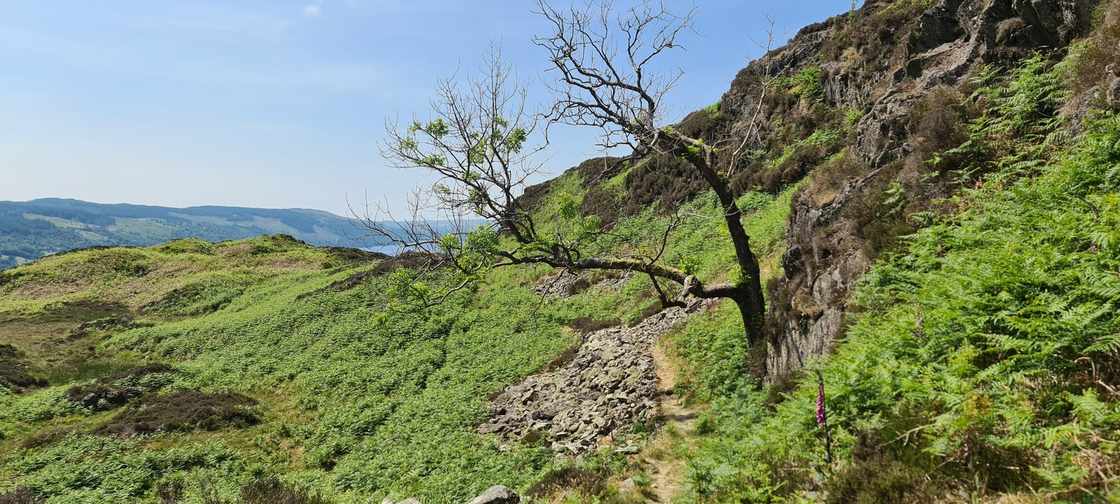
The path you walked up today almost certainly didn’t just happen. Somebody built it — by hand, stone by stone. Fix the Fells puts stone pitching at around £200 a metre. At that rate a kilometre would come to £200,000, though a real project costs whatever its ground demands. You’re walking on it, whether you know it or not.
Much of that work is done by Fix the Fells (opens in new tab), a partnership led by the National Trust. This is the story of what’s under your boots, how to read it, and how to give a little back.
Why the fells need fixing
The Lake District is a World Heritage Site, and the National Park Authority estimates it had 17.45 million tourists in 2025 (its tourism figures (opens in new tab)). Fix the Fells’ FAQ says just one of the paths up Scafell Pike is used by more than 100,000 people a year. Boots are heavy on soft ground: rain follows the compacted line, water cuts a channel, walkers step around the wet, and a footpath widens into a scar. Left alone, the damage runs away with itself. The same FAQ gives Coledale near Keswick as a past example of how far it can go: a scar that grew to 30 metres wide and 4 metres deep — wide enough to swallow a tennis court, deep enough to lose a bus in.
The point of the work isn’t to make the fells easier or safer — it’s to repair erosion sustainably, so the mountain heals and the ground beside the path can recover.
How to read a fell path
Once you know what to look for, a repaired path tells you how it was made. Tap the numbers to see what’s under — and beside — your boots.
Read the path
Tap a number on the drawing to see how that part is built.
A schematic, not to scale — a single path rarely shows every technique at once. Find a cross-drain on your next walk: once you’ve spotted one, you’ll see them everywhere.
How to walk kindly — and make their job easier
Every walker either adds to the erosion or helps hold it back, and it costs nothing to be on the right side:
- Walk through the puddle, not around it. Skirting the wet is exactly how a path doubles in width, so boots on the built line and wet feet. Shallow standing water and mud, that is — no path is worth wading a beck in spate or water you cannot see the bottom of. If the built line is under deep or moving water, turn back or take the safest way past it.
- Don’t shortcut the zig-zags. Cutting the corner off a pitched zig-zag starts the next scar. The long way round is the kind way.
- Leave the drains and the stones be. Don’t dam a cross-drain into a paddling pool, and leave loose stones in the path — they’re not litter, they’re building material.
- Keep off the fragile edges and the reseeding ground beside a fresh repair — and don’t build cairns: a pulled-up stone is a stone off the mountain.
What it costs to keep the fells walkable
None of this is cheap. Fix the Fells funds its work through donations, grants, visitor giving, sponsorship and contributions from its partner organisations, and a grant can be public money: its 2025 repair of a Grasmere path was paid for with £34,070 from the UK Shared Prosperity Fund (their project news (opens in new tab)).
The costs are Fix the Fells’ own estimates. Its FAQ (opens in new tab) gives about £200 to repair a metre of stone pitching, £60,000 a year for helicopter lifts of stone to ground that can’t be reached on foot, and £500,000 a year as what it needs to maintain its existing network. Its 2025 annual report says building or repairing a path can cost up to £400 a metre: the top of the range, not an average. Here is one year, 2025, from that annual report (opens in new tab):
Source: Fix the Fells Annual Report 2025 (opens in new tab), its introduction and the “2025 in numbers” page (printed page 6). The 421 km is path the volunteers maintained that year, not new path and not the whole network.
How big is the whole network? Fix the Fells’ homepage (opens in new tab) says it repairs and maintains 344 upland paths covering 410 miles, while its FAQ (opens in new tab) gives 335 paths covering 400 miles. Neither page dates its figure, so we quote each one with its page rather than pick between them.
Behind the figures are people. In 2025, 147 volunteers gave 3,206 days — ordinary walkers who, the annual report says, visited every path multiple times over the year, keeping the drains clear and making “stitch in time” repairs before the water could do more damage. The main repair season is March to October, and the volunteers carry on maintaining the paths through the winter.
One path, close up: Gowbarrow
The gentle path around Gowbarrow, above Ullswater
It looks effortless — which is the whole point. Fix the Fells has been repairing it since 2013, and its Gowbarrow page reports 570 ranger-days at a cost of around £114,000, with 233 volunteer-days, over “the last 5 years”, a stretch the page does not date — so read that as the project period they describe, not the last five years from today. Volunteers visit monthly to keep the drains running. Boggy, widening sections were rebuilt as buried aggregate paths, with stone pitching on the steeper pulls and little stone risers to ease the gradient — all to protect the fragile habitats that Grass of Parnassus, Cumbria’s county flower, bog asphodel and the ringlet butterfly depend on.
Source: Fix the Fells — Gowbarrow (opens in new tab). See it on the Aira Force & Gowbarrow route.
Give a little back
So the next time a path steps you neatly up a steep pull, or carries you dry over a bog — now you know what it took, and what it’s worth: around £200 a metre, laid by hand, and kept going by a partnership led by the National Trust and by its volunteers. A few pounds genuinely helps keep the fells walkable and the mountainsides healing.
Donate to Fix the Fells → (opens in new tab)Path-repair figures and project detail are published by, and © Fix the Fells — a partnership of the National Trust, the Lake District National Park Authority, Natural England, the Lake District Foundation and Friends of the Lake District, led by the National Trust, which its partners page (opens in new tab) names as the major funder at present — and are reproduced here as editorial provenance, with dates and links, not as our own claim. We last checked every figure on this page on 30 September 2026 against the page it is cited to: Fix the Fells’ FAQ (opens in new tab), homepage (opens in new tab), funding (opens in new tab) and partners pages, Gowbarrow (opens in new tab) page, Grasmere project news (opens in new tab), path-repair techniques (opens in new tab) page and 2025 Annual Report (opens in new tab) (the 2025 figures from its introduction and printed page 6), and the National Park Authority’s tourism figures (opens in new tab). That check confirms each figure says what its source says; the measuring is theirs. Network and cost figures differ between Fix the Fells’ pages, so each is cited to its own page. See also our data sources.